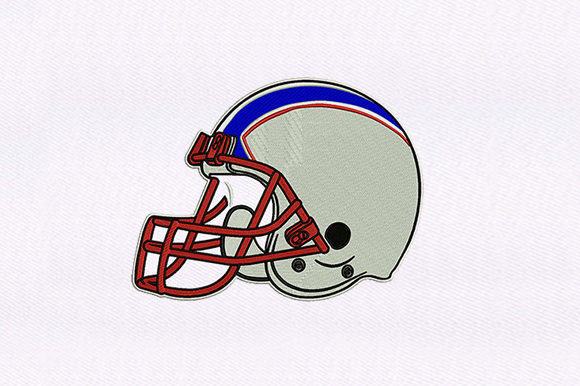
Football Player Helmet Embroidery Design Review
First Impression: Bold, Playful, and Instantly Recognizable
As an embroidery designer who’s digitized and stitched hundreds of sports-themed assets for small businesses, my first read on Football Player Helmet is clear: it’s a confident, high-energy machine embroidery design built for visibility—not subtlety. The title alone signals strength, tradition, and team spirit, making it ideal for local gyms, youth leagues, school shops, or even non-sports brands leaning into athletic energy (think a fitness café or active-lifestyle boutique). It doesn’t whisper—it announces. That makes it especially valuable for small business merch where shelf presence and instant recognition matter more than delicate nuance.
Real-World Business Use: From Patches to Product Identity
Football Player Helmet shines across multiple commercial embroidery applications—especially when consistency and brand cohesion are priorities. As an embroidered patch, it holds up beautifully on denim jackets, staff aprons, and tote bags for local events or pop-up markets. Its strong silhouette translates well at 2.5”–3.5” sizes—common for chest logos on custom apparel or cap embroidery front panels. I’ve used similar designs for florists adding “Team Bloom” patches to canvas aprons, and for pet brands stitching helmet motifs onto dog-walker vests—proving its versatility beyond literal football contexts.
For boutiques and Etsy sellers, Football Player Helmet works as a subtle but memorable branded accent: think sleeve detail on organic cotton tees, a minimalist back-of-cap mark for artisanal headwear lines, or a reinforced corner motif on reusable shopping totes. When paired with clean typography or a simple monogram, it elevates handmade product perception without overwhelming the item’s core aesthetic. And because it reads clearly at medium scale, it integrates smoothly into printable mockups—helping clients visualize final products before production begins.
Where to Use It Thoughtfully (Not Everywhere)
Like any strong visual asset, Football Player Helmet demands thoughtful placement. Avoid shrinking it below 1.75” unless you’ve tested the embroidery file for stitch density and legibility—fine outlines or tight contours may collapse or blur on curved surfaces like cap fronts or knit polos. On textured fabric (terry cloth, heavy twill, or fleece), extra stabilizer is non-negotiable; otherwise, thread tension issues can mute definition. Dark uniforms require high-contrast thread colors—navy + gold or black + white combos consistently outperform low-contrast pairings in real-world wear testing.
Also consider longevity: if your small business merch includes items meant for frequent washing (e.g., staff work shirts or café aprons), verify that the design’s fill areas aren’t overly dense—excessive stitch density increases stiffness and wear risk over time. Always test on your actual fabric, not just a scrap swatch, and inspect spacing between elements to ensure no gaps close up during hooping or stitching.
Brand Identity Impact: More Than Just a Motif
When embedded intentionally, Football Player Helmet does more than decorate—it communicates values. For a local bakery launching a “Sunday Game Day” special, it signals community, fun, and shared ritual. For a creative studio branding client gift boxes, it adds energetic polish without sacrificing craftsmanship. That duality strengthens customer trust: people recognize quality embroidery as intentional effort, and Football Player Helmet, when executed cleanly, reads as professional—not generic.
It also supports visual consistency across touchpoints. Use it as your primary embroidered patch on staff uniforms, then echo its shape subtly in digital design assets (social banners, email headers) or even packaging accents. That repetition builds recognition faster than standalone graphics—and reinforces your handmade product story without needing words.
Practical Designer Notes Before You Stitch
Before committing to bulk production, run these checks:
- Test in black and white first. This reveals contrast issues and helps assess how well the design reads without color distraction.
- Verify patch-size performance. Resize your embroidery file to your target dimensions (e.g., 2” wide) and zoom in—look for jagged edges, floating threads, or overcrowded zones.
- Review thread color contrast on your base fabric. A gold thread may dazzle on navy but vanish on khaki—always sample.
- Inspect spacing and underlay. Tight lettering or narrow gaps need proper underlay to prevent gapping after washing.
- Confirm hoop size compatibility. If your embroidery machine has limited hoop clearance, ensure the design fits without re-hooping mid-stitch.
- Use appropriate stabilizer. Cutaway for knits, tear-away for stable wovens, and fusible + cutaway for stretchy or lightweight fabrics.
- Create a physical mockup for client approval. A stitched sample on actual fabric beats any digital preview.
- Compare alongside other design assets. Does Football Player Helmet harmonize with your logo, fonts, and secondary icons?
- Confirm commercial licensing. Since this is a digital embroidery file intended for small business merch and branded patch use, ensure the license permits resale, redistribution, and commercial embroidery projects—don’t assume.
Finally, remember: Football Player Helmet isn’t just a Sports category embroidery file—it’s a flexible brand amplifier. Whether you’re building custom apparel for a youth league, launching embroidered tote bags for a local florist, or designing staff uniforms for a craft brewery, this machine embroidery design delivers personality with purpose—if you treat it like the strategic asset it is.